
The Modern Sculptor: A Deep Dive into CNC Stone Routers

In the world of masonry and interior design, the hammer and chisel are becoming more like ceremonial artifacts than primary tools. Taking their place is the CNC (Computer Numerical Control) Stone Router—a powerhouse of precision that turns massive slabs of granite, marble, and quartz into intricate works of art.
Whether you're a shop owner looking to upgrade or just a fan of how things are made, here is everything you need to know about these robotic stonemasons.
What Exactly is a CNC Stone Router?
At its core, a CNC stone router is a computer-controlled cutting machine. Unlike its wood-carving cousins, the stone router is built with extreme rigidity and uses diamond-tipped tools and high-pressure water-cooling systems to carve materials that would otherwise shatter or dull standard bits.
It operates on a multi-axis system (usually 3, 4, or 5 axes) to move a spindle across a stone slab based on a digital blueprint.
How It Works: From Pixels to Pillars
The process is a perfect marriage of digital design and heavy-duty engineering:
CAD Design: A designer creates a 2D or 3D model using software like AutoCAD or Rhino.
CAM Conversion: The design is converted into G-code, a language the machine understands, detailing every coordinate and movement.
The Cut: The router uses a water-cooled spindle to execute the path. The water is crucial—it prevents the diamond bits from overheating and keeps hazardous stone dust from becoming airborne.
Key Applications
Why are fabrication shops investing hundreds of thousands of dollars into these machines? Because they can do things no human hand can replicate with the same speed and consistency.
Countertops & Sinks: Creating perfect sink cutouts, decorative "ogee" edges, and polished drainboards.
Architectural Elements: Carving intricate fireplace mantels, columns, and ornate moldings.
Monumental Masonry: Etching high-detail portraits and lettering onto headstones and memorials.
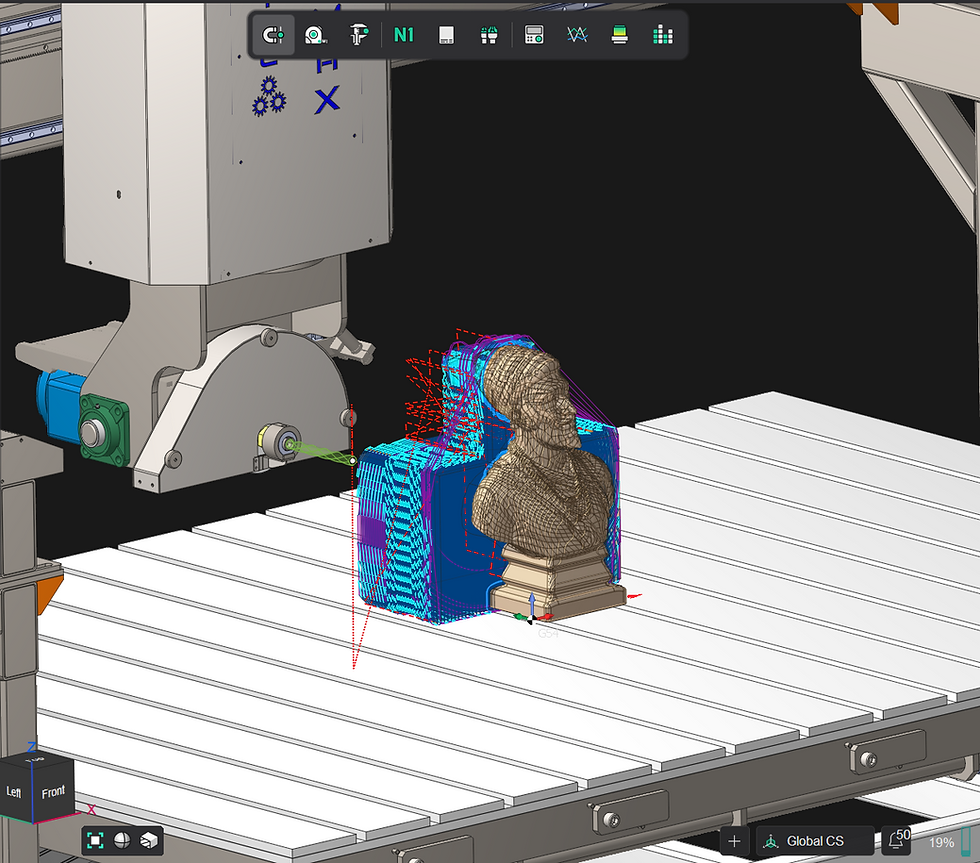
3D Sculpting: 5-axis routers can actually "sculpt" complex statues from a solid block of stone.
ency cam | 3 axis Milling | Swiss Lathe | Multiaxis | CUBE CADTECH

CNC Stone Routers
Why Go CNC? (Pros vs. Cons)
Feature | The CNC Advantage | The Reality Check |
Precision | Accuracy within fractions of a millimeter. | Requires high-level technical training to operate. |
Efficiency | Can run 24/7 with minimal supervision. | High initial investment and maintenance costs. |
Safety | Reduces manual handling and dust exposure. | Requires specialized water filtration systems. |
Complexity | Handles complex 3D curves easily. | Tooling (diamond bits) can be expensive to replace. |
Export to Sheets
The Future of Stone Fabrication
We are currently seeing a shift toward 5-axis technology becoming the industry standard. A 5-axis machine doesn't just move left, right, up, and down; the head can tilt and rotate. This allows the machine to undercut and carve shapes that were previously impossible without manual finishing.
Furthermore, integration with AI-driven nesting software is helping shops reduce waste by calculating the absolute best way to fit multiple parts onto a single expensive slab of marble.
Final Thoughts
The CNC stone router isn't just a tool; it's a bridge between ancient materials and futuristic technology. While the "soul" of stonework will always involve a designer's eye, the heavy lifting—and the incredible precision—is now firmly in the hands of the machines.

How ENCY CAM CAN Optimize your work
While the hardware provides the muscle, the software is the brain. In the world of stone fabrication, ENCY (often misspelled as ECNY) CAM has emerged as a gamechanger. It’s not just a basic toolpath generator; it’s a comprehensive ecosystem designed to bridge the gap between complex digital designs and the physical reality of a 5-ton stone router.
Here’s how ENCY CAM elevates stone fabrication:
1. "Machine Awareness" & Digital Twins
One of ENCY’s standout features is its Machine Awareness. Traditional CAM software often just looks at the part being made. ENCY looks at the entire machine.
The Digital Twin: It builds a 3D digital replica of your specific router (its limits, its head size, its table).
The Benefit: It knows if the spindle head is going to hit a clamp or if the machine's arm can actually reach a specific corner before you start the cut. In stone, where a single mistake can waste a $3,000 marble slab, this is a financial lifesaver.
2. Specialized Strategies for Stone (3D & 5-Axis)
Stone isn't wood; it’s brittle and heavy. ENCY offers advanced multi-axis toolpaths specifically optimized for stone:
Roughing & Finishing: It calculates "Adaptive" paths that maintain a constant load on the diamond bits, preventing them from snapping or burning out.
5-Axis Sculpting: For complex statues or ornate fireplace mantels, ENCY handles 5-axis movements smoothly, ensuring the tool is always at the optimal angle to the stone surface for the best finish.

AI CAM Software
3. AI-Driven Performance
The latest versions of ENCY have integrated AI-driven automation.
Smart Hints: The software suggests the best machining parameters based on the material and tool type.
Auto-Transitions: It automatically calculates the safest and fastest way for the tool to move from one part of the stone to the next, reducing "air-cutting" time and increasing your shop’s daily output.
4. G-Code Verification (ENCY Tuner)
Many fabricators fear "G-code" errors. ENCY includes a module called ENCY Tuner, which allows you to simulate and verify the actual NC-code.
Voxel Simulation: You can see a high-res, 3D simulation of the material being removed. If there’s a collision or an error in the code, the software highlights it in red, allowing you to fix it on your computer rather than breaking a tool on the shop floor.
5. Seamless Robot Integration
If your "stone router" is actually a robotic arm (increasingly common for large-scale sculptures), ENCY is one of the few platforms that treats robots and CNC machines exactly the same. It manages the complex kinematics of a 6-axis robot just as easily as a 3-axis bridge saw.
Summary: Why it Matters
Using a high-end stone router with basic software is like putting a lawnmower engine in a Ferrari. ENCY CAM unlocks the full potential of your hardware by:
Reducing Waste: Catching errors in simulation.
Saving Time: Automating the complex math of 5-axis movements.
Extending Tool Life: Using "Machine-Aware" toolpaths that treat your expensive diamond bits with respect.
Considering an upgrade to your software workflow? Whether you're doing simple kitchen countertops or museum-grade sculptures, ENCY provides the precision needed to turn "just a slab" into a masterpiece.
Does your current setup use a traditional bridge saw, or are you moving straight into a multi-axis CNC or robotic arm?


Comments