
Formula 1: The Role of CAM in Precision Manufacturing

Updated: Aug 10
Formula 1 is often described as a sport decided on Sunday but won during the week — in the wind tunnel, the design office, and above all, the machine shop. A modern F1 car has more than 10,000 individual components, many of them redesigned and rebuilt every few weeks as teams chase fractions of a second. Behind that relentless pace sits a quiet but crucial technology: Computer-Aided Manufacturing (CAM), working hand-in-hand with CNC machines and robotics to turn digital designs into race-ready parts with near-impossible precision. Platforms like EncyCAM sit at the heart of this pipeline, translating CAD models into the toolpaths that drive the machines on the factory floor.
Here's how that pipeline works, and why it matters so much for a team like Scuderia Ferrari.

Why F1 Parts Are So Hard to Manufacture
F1 components aren't just small — they're extreme in almost every dimension:
Tolerances measured in microns. Suspension uprights, gearbox internals, and hydraulic components often need tolerances tighter than a human hair's width.
Exotic materials. Titanium alloys, Inconel, carbon-fibre composites, and aerospace-grade aluminium are standard, and each behaves differently under a cutting tool.
Extreme geometries. Aerodynamic parts have compound curves, thin walls, and internal channels that are nearly impossible to machine with manual methods.
Insane time pressure. A part might go from CAD file to fitted-on-car in under 48 hours during a triple-header race weekend.
This combination — ultra-tight tolerances, difficult materials, complex shapes, and brutal deadlines — is exactly the problem CAM and robotics were built to solve.
What ENCY CAM Actually Does
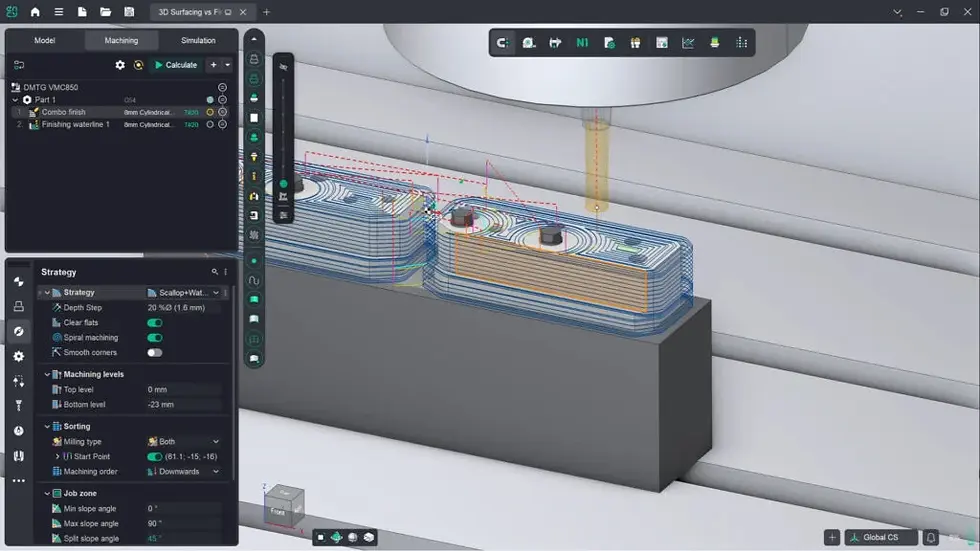
CAM software takes a 3D CAD model and converts it into machine-readable toolpaths — the precise instructions that tell a CNC machine or robotic arm exactly how to cut, mill, drill, or shape a part. A platform like EncyCAM handles this translation layer, sitting between the design office and the shop floor. In an F1 context, this does several things design engineers alone can't:
Simulates the entire cut before it happens. Engineers can use EncyCAM to catch tool collisions, material stress points, or inefficient paths virtually, saving hours of wasted machine time.
Optimizes for speed and accuracy. CAM software calculates the most efficient toolpath that still respects surface finish and tolerance requirements — critical when a part might only get one shot at being right.
Feeds 5-axis machining centers. Rather than repositioning a part multiple times (introducing error each time), CAM-generated programs let a single setup machine a part from nearly every angle.
Links directly back to design. When aerodynamicists tweak a wing profile after a wind-tunnel run, the updated CAD model can flow almost directly into an updated EncyCAM toolpath — compressing the design-to-part cycle dramatically.

Where Robotics Comes In
CAM tells the machine what to do; robotics and CNC automation are how it gets done reliably, at scale, and around the clock.
Robotic composite layup. Carbon-fibre parts — monocoques, wings, floors — are built from dozens of layers of pre-preg carbon sheet, each oriented at a specific angle for strength. Robotic arms can place these layers with a consistency no human hand can match, reducing voids and weak points before the part even goes into the autoclave.
Multi-axis CNC machining. 5-axis (and increasingly more complex) CNC centers, guided by CAM-generated programs, machine metal components continuously without manual repositioning, holding tolerances that stay consistent part after part.
Automated inspection. Robotic arms fitted with laser scanners or coordinate-measuring probes check finished parts against the original CAD model, flagging deviations of a few microns before a part is ever bolted to the car.
24/7 production capacity. Robotic cells don't tire or lose precision on the night shift, which matters enormously when a factory is producing dozens of iterative part revisions in a single week.
Precision as a Competitive Advantage
In F1, manufacturing precision isn't a back-office detail — it's directly tied to performance:
Aerodynamic accuracy. A wing element off by even half a millimetre can measurably change airflow and, over a season, cost meaningful lap time.
Reliability. A single out-of-tolerance gearbox or suspension component can end a race — or a driver's weekend — before it starts.
Rapid iteration. Because CAM and robotics compress the time between "new idea" and "trackside part," teams can bring upgrades to more races per season, rather than saving them for a handful of big updates.
Weight optimization. Tighter, more repeatable manufacturing allows engineers to design parts closer to their theoretical minimum weight, since they can trust the process to hit the exact geometry specified — without extra material added "just in case."
The Bigger Picture
What makes this especially interesting is that the technology isn't exclusive to motorsport — CAM software and robotic machining cells are used across aerospace, medical devices, and industrial manufacturing. What sets F1 apart is the speed at which teams push these tools: design-to-track cycles measured in days, not months, with a level of iteration that most industries never attempt.
For a team competing at the level of Scuderia Ferrari, CAM and robotics aren't just efficiency tools — they're part of the performance package itself, as important to lap time as the engine or the aerodynamics they help build. The car that crosses the finish line first is, in a very real sense, also the product of the most precise machine shop.
Conclusion
In conclusion, the integration of CAM and robotics in Formula 1 is not merely a technological advancement; it is a necessity for success. The ability to produce high-quality parts quickly and accurately gives teams a significant edge. As I reflect on the impact of these technologies, it becomes clear that they are essential for any manufacturing business aiming to stay competitive in today's fast-paced environment. Embracing these innovations can lead to improved efficiency and performance, making them invaluable assets in the world of high-stakes racing and beyond.


Comments